
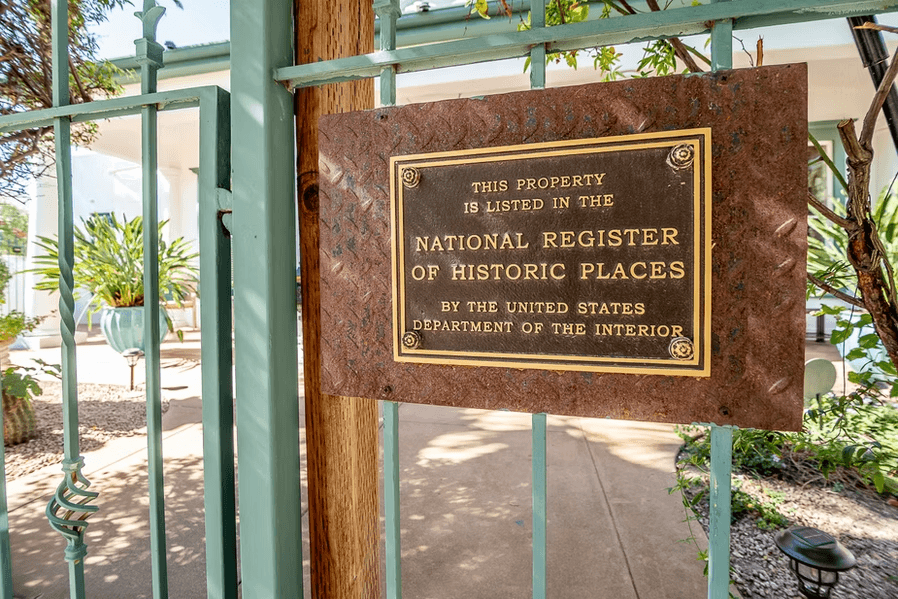
A True Historic Landmark
The Blenman Inn offers guests the rare opportunity to stay within one of Arizona’s oldest and most distinctive homes. Constructed in 1878, the Blenman House is believed to be the only known example of a San Francisco Victorian built in Territorial-style adobe—making it a true architectural and historical landmark. Its story is deeply intertwined with the early formation of Tucson and the American Southwest, dating back to a time when the region transitioned from Spanish and Mexican rule to become part of the United States through the Gadsden Purchase.
Set against the backdrop of the Civil War, the Indian Wars, and the expansion of the Southern Pacific Railroad, the home was built by Charles Rivers Drake, a Civil War veteran, entrepreneur, and civic leader. His vision, paired with the strategic importance of Tucson during this era, positioned the property at the crossroads of frontier life, military presence, and westward expansion.
For more than a century, the mansion evolved alongside Tucson itself—from a private family residence to apartments, and eventually to a lovingly restored historic inn. Today, it stands as both a preserved piece of history and a welcoming retreat, where guests can experience old-world charm, thoughtful hospitality, and the enduring legacy of the American West.
Chronological History
Pre-1870s: Foundations of the Region
Prior to the early 1850s, Tucson and Southern Arizona were part of Mexico, and earlier, Spain.
The Treaty of Guadalupe Hidalgo (1848) transferred vast territories—including much of the modern Southwest—to the United States for $15 million.
In 1852, the Gadsden Purchase secured additional land (including Tucson) for $10 million to support a southern transcontinental railroad vision led by James Gadsden.
During the Civil War (1861–1865), Confederate forces briefly occupied Tucson, raising their flag at the Presidio. The California Cavalry later pushed them back, marking Tucson as the westernmost Civil War battlefield.
Following the Civil War, the Indian Wars continued throughout the 1870s, with figures like Geronimo and Cochise active in the region.
1878: Construction of the Home
Charles Rivers Drake (born 1843 in Illinois), a Civil War Navy veteran and former hospital steward, broke ground on the home in 1878.
He selected the site due to:
Its midpoint location along a 1,000-mile Southern Pacific Railroad segment
Access to fresh water from the Santa Cruz River
Protection from nearby Fort Lowell
Drake contributed to railroad construction, assisted with medical care at Fort Lowell, and supported soldiers during the Indian Wars.
Drawing on his San Francisco mercantile background, he imported fir woodwork, hardware, and two 200-pound leaded glass skylights by wagon for the home’s construction.
Drake became a prominent local figure—developing downtown Tucson, serving in public offices, representing Hercules Powder Co., and advocating for the University of Arizona in the Territorial legislature.
He married Agripina Moreno in 1872 (they had seven children; she died in 1888), later remarried Kate Seeley, and eventually moved to California in 1901, where he built the Virginia Hotel. He died in 1928.
1905–1995: The Blenman Family Era
In 1905, Louise Springer Blenman purchased the home “out of her own separate monies.”
She contributed to Tucson’s cultural development, helping fund the Temple of Music and Art and securing a grant for the Carnegie Library (now the Children’s Museum).
Her husband, Charles Blenman—an Oxford-educated attorney—practiced law in Tucson for over 45 years and was widely known as “Judge” or “Barrister.” He was known for his patriotism, hospitality, and storytelling, and installed the home’s original flagpole.
Their sons:
William Blenman: Graduated from the U.S. Naval Academy (1936), became a Rear Admiral (1958), and returned to Tucson in 1960.
Charles Blenman Jr.: Naval Captain, pilot (from 1937), later worked at the University of Arizona and NASA Ames Research Center, overseeing Pioneer 10 & 11 and Jupiter/Saturn missions.
The family occupied the home for approximately 90 years.
After William’s death, his wife Alice transferred the home to the Tucson Heritage Foundation in 1995.
When the last family member left in 1995, ownership passed to the Arizona Pioneers Historical Society per a will written in the 1930s.
1940s–1990s: Transition
In the 1940s, the home was subdivided into apartments.
By the 1990s, the Arizona Pioneers Historical Society lacked sufficient membership to maintain ownership.
Mrs. Blenman left in 1995, the non-profit sold it to a professor, Dean Saxon, who then sold it to Royal Henry in 1998 who did extensive historic preservation and restoration work.
1998–Present: Restoration and Inn Era
In 1998, the home was purchased by Royal Henry and his wife Yvonne Elizabeth.
After extensive restoration, the “Royal Elizabeth B&B” opened in 1999.
Renovations included:
Restoring original woodwork, doors, and trim preserved in the attic
Rehabilitating historic outbuildings (carriage house, kitchen, bunkhouse)
Adding a pool and spa
Since then, the property has operated continuously as a bed & breakfast and now as an inn.
Today, it remains a carefully preserved historic property, offering guests old-world charm alongside modern amenities and hospitality.
The Current Blenman Inn
Today, The Blenman Inn remains a carefully preserved historic property, offering guests old-world charm alongside modern amenities and hospitality.